
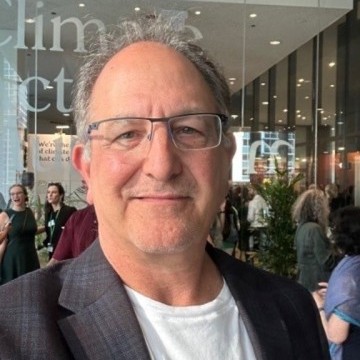
We face economic, environmental, and social challenges every day that require sustainable solutions. Entrepreneur, scientist, and author Robert Colangelo talks with experts across a variety of global sectors – Energy, Transportation, Food, Agriculture, Water & Waste Management, Climate, and more. Robert and his guests explore practical, cost-effective, and innovative solutions. You’ll hear objective facts to help you make informed choices so that your lifestyle and business can be more sustainable.
Download our complete library of podcasts from Spotify and Apple. The Green Sense Minute aired every week on 780 AM & 105.9 FM, WBBM Newsradio in Chicago.
Episodes

Friday Aug 31, 2018
Friday Aug 31, 2018
The livestock industry is responsible for nearly 15 percent of global greenhouse gas emissions, according to the UN. That puts it on par with transport. One way to reduce those emissions is to help cattle, buffalo, sheep and goats with their digestion so they burp less! Bezoar Laboratories in Texas is working on how to do that and we’re joined by founder Elizabeth Latham.
We’ve heard how climate change could lower our national defences, destroy our homes, make the weather uncomfortably hot or cold more often, damage our economy, make food more scarce. But hows this for getting your attention: it could ruin the internet! That’s what’s being explored in a new study co-authored by Paul Barford, a professor with the computer sciences department at the University of Wisconsin - Madison.

Tuesday Aug 14, 2018
Tuesday Aug 14, 2018
The town of Denton, Texas could become the 2nd city in the Lone Star State to go 100% renewable energy with its new plan to reach that goal in the coming years. To explain more, we talk with Jessica Rogers, Deputy Director of Public Affairs for the City of Denton.
Plastic waste continues to clog our oceans, waterways and landfills. And, we’ve dedicated many programs to how keep adding to it. But also, the problem remains of getting rid of the waste that already exists. A new report by the Earth Engineering Center at the Grove School of Engineering of the City College of New York suggests it could be transformed into usable energy. We’re joined by Dr. Marco Castaldi with the school’s Chemical Engineering Department.
Thursday Jul 12, 2018
Thursday Jul 12, 2018
The cosmetics company Lush recently created a video to promote ‘shampoo bars,’ which are like a bar of soap for your hair and don’t need to be contained in a plastic bottle, so there’s no plastic waste. That video helped sell thousands of the bars in a matter of days and, bring attention to an important issue. Someone who was involved in its creation was Katrina Poulos with Lush, who joins us.
We’ve known for years of the environmental issues from coal fired power plants and the dirty air they expel. But we’re still learning about specific health problems they can cause. Recent research shows closing coal-fired plants increases fertility and decreases the number of pre-term births for people living nearby. Dr. Joan Casey of U.C. Berkeley contributed to a recent study.
Friday Jun 29, 2018
Friday Jun 29, 2018
The British company MacRebur takes plastic waste that would end up in landfills and uses it in paving roads. They say it makes for stronger, leaner and greener roads. And, we’re joined by MacRebur CEO Toby McCartney on Green Sense.
Seeing how people in the past looked toward the future can help us here in the present day. A new documentary about the Minnesota Experimental City project, 10-bilion-dollar “city of tomorrow” that being planned in the 1960s. It would produce minimal waste and pollution and offer the new technology and would be an answer to the urban blight and threat of over population. It’s a fascinating story of big ideas and big personalities. We’re joined by Chad Freidrichs, director of the film “The Experimental City.”
Wednesday Jun 27, 2018
Wednesday Jun 27, 2018
Four-door sedans are as American as apple pie and baseball. And, the company that did more than anyone else when it comes to American automobile manufacturing will soon be phasing them out. Here to tell us more about this big bombshell of an announcement from Ford is Consumer Guide Automotive publisher Tom Appel.
Coal power generation in recent years saw an incredible drop not because of laws and regulations but instead because of the availability of other sources. It’s something covered in the research by Dr. Harrison Fell, professor of resource economics with North Carolina University.
Wednesday Jun 20, 2018
Wednesday Jun 20, 2018
There’s a lot of talk when it comes to water issues around the world. The challenge is to get people excited and inspired about important issues like water and that’s one of the aims of the Museum of Water, a traveling exhibit that started five years ago, curated by Amy Sharrocks.
Using cleaner sources of energy isn’t just good in the long term because of its less likely to contribute to climate change, but there’s a connection to alternative sources of energy with long-term health of human beings. To tell us more about his ongoing research is Geoscientist Scott Montgomery with the University of Washington’s Jackson School of International Studies.
Friday May 11, 2018
Friday May 11, 2018
A new report on food waste continues to show the shocking reality of the problem: Americans waste 915 pounds of food per person every year. The report also finds that the largest share of food loss and waste in North America, occurs at the consumer level. To help us understand some solutions to the problem, we’re joined by David Donaldson with the Commission for Environmental Cooperation which came out with the report.
Insects could be a sustainable, protein-rich food source for humans. Because it doesn’t sound appetizing to many, the biggest challenge seems to be getting humans to want to eat bugs! But what about getting the animals we eat to eat insects? That’s what they do at Enterra located in British Columbia, Canada. We’re joined by Victoria Leung who’s in charge of marketing & operations.
Wednesday May 02, 2018
Wednesday May 02, 2018
A 20-million-dollar prize to innovators coming up with ways to solve humanity’s grand challenges is being split 10 ways among the Carbon XPRIZE finalists who were just announced. Joining us with a look at the winners is Dr. Marcius Extavour, XPRIZE senior director of Energy and Resources.
Autonomous cars continue to make headlines. While offering reduced accidents, reduced fuel usage, not to mention the ability to allow the driver to kick back and at let the car do much of the driving, it still leaves unanswered legal questions. Attorney Art Harrington of the law firm Godfrey & Kahn in Milwaukee is part of an upcoming autonomous car symposium which examines these issues.
Thursday Apr 19, 2018
Thursday Apr 19, 2018
Earth Day weekend will be celebrated by nearly a billion people worldwide. We speak with Earth Day Network President Kathleen Rogers about this year's Earth Day theme, and how to best live up to it: reducing plastic pollution.
Drinking from a plastic water bottle likely means sipping microplastic particles with just about every mouthful. This is from a new study from the nonprofit journalism organization Orb Media and State University of New York at Fredonia. We're joined by Professor of Chemistry Sherri Mason on the possible health hazards involved.
Tuesday Mar 27, 2018
Tuesday Mar 27, 2018
The monarch butterfly population has declined more than 80 percent in the past 20 years. And, the latest numbers aren’t very encouraging. What does the monarch population tell us about the state of food safety, what could it mean if we lose this species, and what can we do to make sure the monarch population becomes healthy again. Bill Freese is Science Policy Analyst with the Center for Food Safety.
Cities continue to be the driving force when it comes to more sustainable ways to generate energy. But for solar energy, there’s great untapped potential for cities. A new report from Environment America provides the Top 10 Ways for Cities to Go Solar. Emma Searson’s part of the Go Solar Campaign with Environment America.